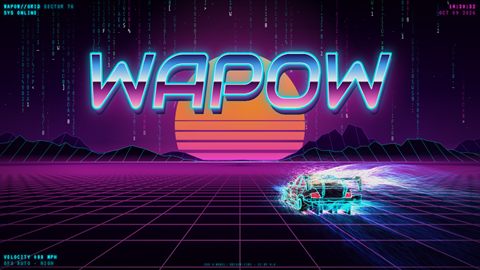
Other dashes show the page you set up. WAPOW reads how you're driving — G-forces, RPM, speed — and reprioritizes the screen for you, in real time. Calm when you cruise. Locked in when you send it.
On the dash it's just the meter — no mode names to read. It rises with how you're driving, and the screen steps up with it.
The 12.3" dash, recorded at its native 1920×720 — the layout it ships with, running the dash's real engines on a simulated drive. Watch the screen step up as the driving builds, and alarms pulse right where they sit.
Written by a crew chief who's watched drivers miss gauges at 100 mph. Every rule exists because attention is the scarcest thing in the car.
Nothing on this screen moves for show. A pulse means a reading went bad. A step up means you're driving harder. Everything else holds still, right where you put it.
Throw it into a corner and the dash steps up before you exit. It only settles back after a sustained stretch of calm, one level at a time — and you set how long. No flickering back and forth mid-session.
Oil pressure tracks RPM. Fuel pressure tracks boost. A "normal" number at idle is a disaster at redline — so WAPOW shows distance from normal-for-right-now. Steady when healthy. Loud when it isn't.
When a reading goes bad, that gauge lights up in its alarm look and pulses twice, quick, right where it sits on your screen. Your eye goes straight to it.
Knock flashes instantly, tagged with the RPM and load where it happened, and logs every event with an unread badge. One tap at the next stoplight tells you exactly what your engine was doing when it pinged.
The layout we ship is a starting point. Rearrange the gauges and alarms, vibe-code your own with an AI, or load one someone else built. The screen is software. The capability is in the hardware.
WAPOW is GPL v3 — the code is free, forever. We make our money selling assembled, tested units so you don't have to solder anything.
Built on years of professional motorsports — pit walls, wrenches, and drivers who couldn't spare a glance — documented on camera from the first breadboard onward. Project car: a 2000 Impreza 2.5RS with an STI heart. Test mule: a 2005 STI. Every failure ships as an episode.
One lap, from idea to your dash.
A dash that reorders itself by how you're driving. Design rules written, first prototype on screen.
Sensors to screen on the bench — Teensy, CAN bus, Raspberry Pi — with two custom boards built and validated.
The whole system in a 3D-printed case. It rode along in an STI in August and logged the entire drive.
Every drive is logged, and the logs become the fix list. The first one changed how the dash shifts between modes.
A 12.3-inch widescreen, WAPOW's own circuit boards, a production case. Screen samples are on order.
FCC testing — the step any electronic product has to clear before it can be sold.
Open once the hardware is final. Not before.
Assembled, tested units, to your door.
Not yet. There are no preorders or deposits today. When they open, Build Log subscribers hear first.
If you're handy, you can start now. The code is free on GitHub, and the parts list is the exact hardware on our bench. The step-by-step build guide isn't out yet.
Marker last moved September 2026
What got built, what broke on camera, and what's next on the bench. Issues go out when the build earns one — roughly monthly when things are moving, quieter when they're not. No spam, no hype — just the build.